
New Features
MAKO-3320
|
Add equivalent of PDFLib's SetPageFilterRange to IDistiller
Three new API functions are added to IDistiller to specify which pages in a PostScript job are processed.
Use it in this way. C++
C#
Java
|
MAKO-3350
|
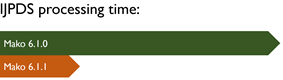
IJPDS Performance improvement
In response to a customer request, the IJPDS input class has undergone significant refactoring that has resulted in an average performance increase of 71%. In particular, the method for obtaining the number of pages now returns almost immediately. |
MAKO-335X
|
IJPDS input class: additional options to control assembly of output pages
The method to instantiate the class remains the same, but the available parameters have changed. C++
C#
A complete list of the available parameters follows. Items marked with an asterisk are new in this version. |
IJPDSInput parameters
|
Parameter |
Possible values |
Description |
|
ripsetup |
|
Default. Each RIP generates its own page. |
|
|
Groups RIPs together in blocks of four to generate a composite page. |
|
|
riporder*
|
|
RIPs are arranged in the order the job defines them. Default. |
|
|
RIPs are arranged sequentially in their ordinal numbering (starting from |
|
|
0,1,2,3… |
A comma-separated sequence of RIP IDs (a number from |
|
|
0,1,3,2 |
Example: For CMYK output it is sometimes necessary to change the plate order (here 0,1,3,2 is specified) to obtain the correct composite output. |
|
|
|
Example: If |
|
|
Parameter |
Possible values |
Description |
|
ripinterleave |
Removed. Replaced by riporder. |
|
|
collation* |
|
Default. Output is ordered in page number major order. All the first pages from each RIP are output followed by the second pages, and so on. |
|
|
|
Output is ordered by RIP major order. All the pages for RIP 1 are output followed by all the pages for RIP 2, and so on. |
|
riprotate*
|
|
This denotes the rotation of a RIP separation in the output page. The value is an angle in degrees, counter-clockwise. Possible values are |
|
|
||
|
|
||
|
|
||
|
stitch* |
|
Individual RIP separations are combined into one page by stitching them together. Default. The orientation of the stitching can be controlled by the |
|
|
Individual RIP separations are each output as separate pages. |
|
|
stitchhorizontal* |
|
The RIP separations are stitched in a horizontal orientation. |
|
|
|
The RIP separations are stitched in a vertical orientation. Default. |
|
resourcedirectory |
|
Sets the directory where remote resources are located (that is, resources referenced by the IJPDS but external to it). |
Distribution
MAKO Version 6.1.1 is built for the following platforms:
-
Linux (for Debian-based distributions, e.g., Ubuntu, Mint)
-
Linux (Centos)
-
Linux (for Debian Stretch)
-
Linux (for MUSL distributions, e.g., Alpine Linux)
-
macOS
-
Windows (static and dynamic libs, VS 2019 (V142), x86 and x64)
Mako supports the following programming languages:
-
C++ (Mako is written in C++)
-
C# (.Net Framework and .Net Core)
-
Java (built with OpenJDK11)
-
Python (v3.8)
The alternatives to C++ are built using SWIG (www.swig.org) which provides a translation to the native libraries, found in these distribution folders:
-
Linux_SWIG_(C#-Java-Python)
-
macOS_SWIG_(C#-Java-Python)
-
Windows_SWIG_(C#-Java-Python)